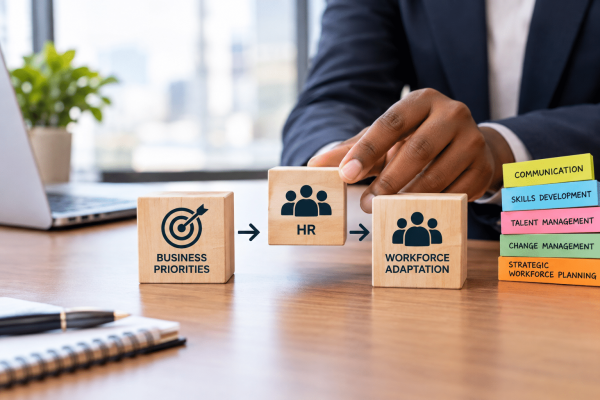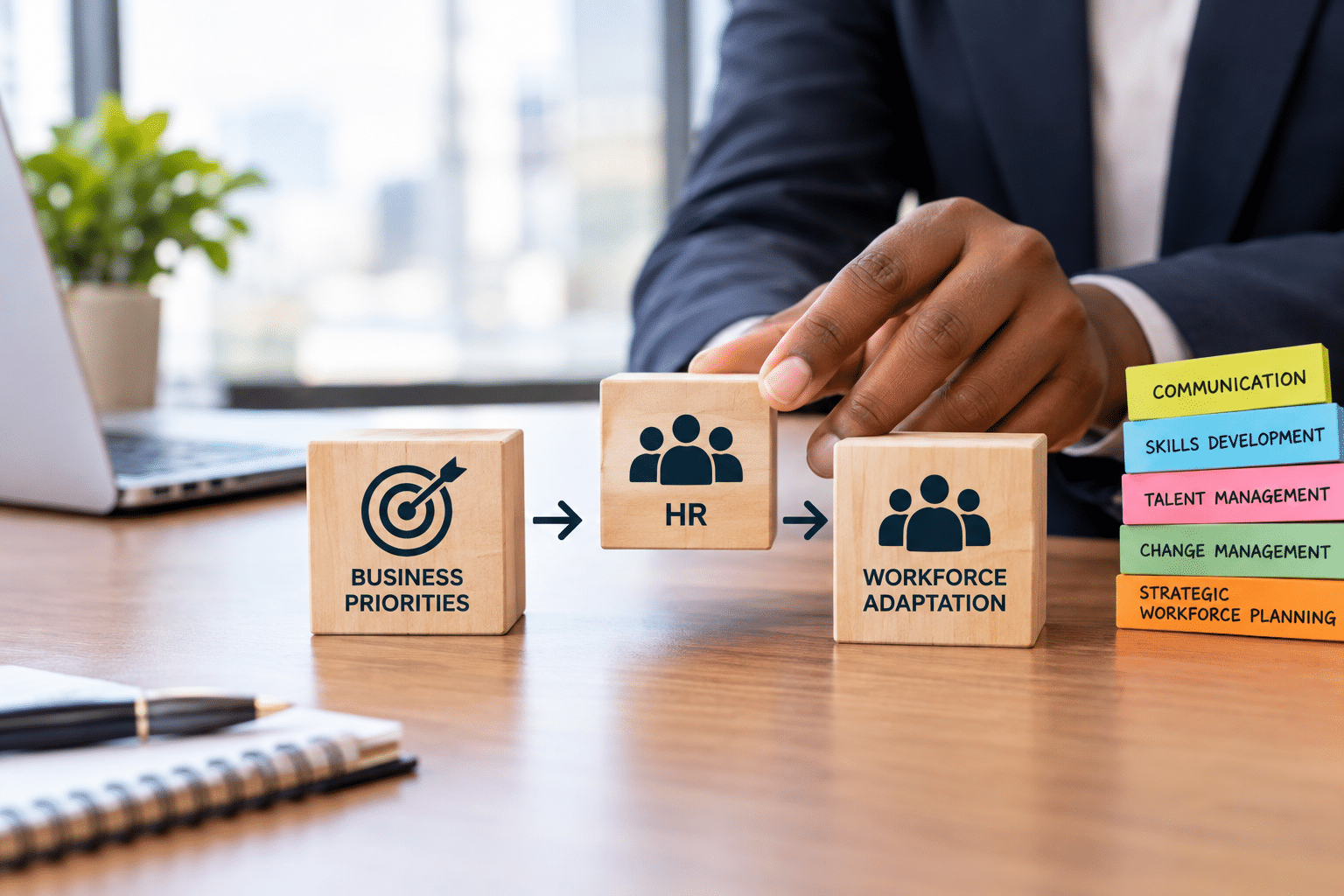
A company can change direction in a single leadership meeting.
A new market opportunity emerges. A major client is lost. Revenue expectations change. Technology alters how work gets done. Expansion plans accelerate. Costs need to be reduced. A new product requires capabilities the organisation does not currently have.
Leadership may make the decision quickly.
The workforce cannot.
People need to understand what is changing, why it matters, what is expected of them, and whether they have the skills and resources required to deliver the new direction.
This is where HR has a role that extends far beyond recruitment, policies, payroll, or employee administration.
When business priorities shift, HR can help translate strategic decisions into practical workforce priorities.
That means asking questions such as:
- Do we have the right people to execute the new strategy?
- Which roles have become more important?
- Which capabilities are missing?
- What skills will employees need?
- How should teams and responsibilities change?
- What needs to be communicated to employees?
- Which people decisions should happen now, and which can wait?
- How do we maintain engagement while expectations are changing?
- What workforce risks could prevent the strategy from succeeding?
The strongest organisations do not treat these questions as an HR exercise that happens after the strategy has already been decided.
They bring HR into the conversation early.
Because a business strategy is ultimately executed by people.
What Does It Mean When Business Priorities Shift?
Business priorities shift when an organisation changes what it considers most important for achieving its objectives.
The change can be strategic, financial, operational, technological, or market-driven.
For example, a company that previously prioritised rapid expansion may suddenly need to focus on profitability. A business that focused primarily on physical operations may begin investing heavily in digital channels. A company that relied on generalist employees may need specialised technical expertise to enter a new market.
These shifts can affect almost every part of the organisation.
Consider a company expanding into a new African market.
The leadership team may initially focus on:
- market entry;
- sales targets;
- customer acquisition;
- regulatory requirements;
- operational costs; and
- local partnerships.
But underneath those priorities are workforce questions.
Who will manage the market?
Does the organisation have people with local market knowledge?
Will existing employees need to relocate?
Should the company recruit locally?
Does the finance team understand the new regulatory environment?
Are managers prepared to lead distributed teams?
Does the organisation have enough people with the necessary technical and commercial skills?
These are not secondary questions.
They can determine whether the business strategy can actually be executed.
Why HR Should Be Involved When Business Strategy Changes
HR is sometimes brought into strategic conversations only after the major decisions have already been made.
Leadership decides to expand, restructure, introduce technology, reduce costs, or change operating models. HR is then asked to “handle the people side.”
That approach creates unnecessary friction.
If HR becomes involved early, it can identify workforce implications before they become operational problems.
HR can translate strategy into workforce requirements
Suppose leadership says:
“We need to become more technology-driven.”
That statement is strategic, but it is not yet a workforce plan.
HR can help translate it into practical questions:
- Which technologies will be introduced?
- Which roles will be affected?
- Which existing skills can be developed?
- Which capabilities need to be recruited?
- How many employees will require training?
- Will job descriptions need to change?
- Are managers equipped to lead the transition?
- How will performance expectations change?
The difference is important.
A business priority describes where the organisation wants to go.
HR helps determine what people, capabilities, structures, and behaviours are required to get there.
1. Start by Understanding What Has Actually Changed
One of the first mistakes organisations make during periods of change is treating every announcement as a workforce transformation project.
Not every strategic change requires a major organisational restructure.
HR should first understand the nature and scale of the change.
Ask what has changed
Is the organisation changing:
- its growth strategy?
- customer segments?
- geographic markets?
- revenue model?
- technology?
- operating model?
- cost structure?
- product portfolio?
- service delivery model?
- organisational structure?
Each type of change has different workforce implications.
For example, entering a new market may create recruitment and compliance requirements.
Introducing automation may create skills-development and job-redesign requirements.
A cost-reduction programme may require workforce prioritisation and organisational restructuring.
A new customer strategy may require sales teams to develop different capabilities.
Then ask what has not changed
This is equally important.
During uncertainty, employees can interpret every strategic announcement as a signal that everything is about to change.
HR can help separate:
What is changing
from
What remains stable.
That distinction can reduce unnecessary anxiety and help employees focus on the areas where action is actually required.
2. Translate Business Goals Into Workforce Priorities
Once HR understands the strategic direction, the next step is translating broad business goals into workforce priorities.
Consider a company whose leadership says:
“We need to improve customer retention.”
That objective could lead HR to examine several areas.
Workforce questions might include:
- Do customer-facing employees have the right skills?
- Are teams sufficiently staffed?
- Are performance targets encouraging the right behaviours?
- Does the organisation reward customer retention or only new sales?
- Do managers have the skills to coach customer service teams?
- Are employees receiving enough customer insight?
- Are there capability gaps affecting service quality?
The business objective is customer retention.
The workforce response might include:
- customer-service training;
- revised performance indicators;
- manager coaching;
- targeted recruitment;
- role redesign;
- improved workforce allocation; and
- stronger internal communication.
This is what strategic HR should do.
It should connect business priorities to people decisions.
3. Conduct a Workforce Capability Assessment
A strategy is only as strong as the capabilities available to execute it.
This makes workforce capability assessment one of the most important steps when business priorities change.
HR should examine the gap between:
Capabilities the organisation has today
and
Capabilities the organisation will need tomorrow.
This is sometimes called a skills gap analysis or workforce capability assessment.
A simple capability framework
HR can assess capabilities across four categories:
| Capability | Current State | Future Requirement | Gap |
|---|---|---|---|
| Leadership | Strong operational leadership | Strategic and change leadership | Moderate |
| Technology | Basic digital skills | Advanced digital capability | High |
| Sales | Strong traditional sales | Consultative selling | Moderate |
| Data | Limited analytical capability | Data-driven decision-making | High |
| Customer Experience | Established processes | Personalised customer engagement | Moderate |
This gives leadership something more useful than a general statement such as:
“We need more skilled employees.”
Instead, HR can identify precisely where capability gaps exist.
Not every gap requires recruitment
This is an important distinction.
A capability gap can potentially be addressed through:
- training;
- coaching;
- mentoring;
- internal mobility;
- job redesign;
- technology;
- outsourcing;
- temporary expertise;
- partnerships; or
- external recruitment.
Recruitment should be one possible solution, not the automatic solution.
4. Use Workforce Planning to Prepare for the New Direction
Workforce planning connects business strategy with workforce requirements.
It helps organisations determine:
- how many people they need;
- which roles they need;
- where those employees need to be located;
- what capabilities they require;
- when those capabilities will be needed; and
- how much the workforce will cost.
This becomes particularly important when priorities change quickly.
For example
Imagine a company decides to expand from Kenya into three additional African markets.
The initial reaction might be:
“We need to hire country managers.”
But strategic workforce planning should go further.
The organisation may also require:
- sales professionals;
- compliance expertise;
- finance support;
- customer service;
- local HR knowledge;
- payroll capabilities;
- operations management;
- technology support; and
- leadership capacity.
It also needs to determine which functions should be local and which can be centralised.
This is where workforce planning becomes a strategic tool rather than simply a headcount exercise.
5. Identify Critical Roles Before Filling Every Vacancy
When priorities shift, organisations can be tempted to recruit quickly.
But not every role deserves equal urgency.
HR can help leadership identify critical roles — positions that have a significant impact on strategic objectives.
A useful assessment can consider:
Business impact
What happens if this role remains vacant?
Scarcity
How difficult is the required capability to find?
Time to productivity
How long would it take a new employee to become fully effective?
Internal availability
Could the capability be developed internally?
Strategic dependency
How many other business activities depend on this role?
This helps HR distinguish between:
Roles that are important now
and
Roles that are important eventually.
That distinction matters when budgets and resources are limited.
6. Revisit Job Descriptions and Role Expectations
A change in strategy often changes what employees actually need to do.
Yet organisations sometimes leave job descriptions untouched for years.
That creates a disconnect between strategy and performance expectations.
Suppose a company shifts from transactional sales to relationship-based account management.
The sales role may now require:
- consultative selling;
- customer relationship management;
- account planning;
- data interpretation;
- negotiation;
- cross-functional collaboration; and
- customer retention skills.
If the job description still focuses primarily on lead generation and closing individual transactions, the organisation is sending conflicting signals.
HR should review:
- job descriptions;
- competency frameworks;
- performance indicators;
- reporting structures;
- decision-making responsibilities;
- career paths; and
- required qualifications or skills.
The goal is not to rewrite every job description whenever leadership changes direction.
It is to ensure that roles remain aligned with the work the organisation actually needs people to perform.
7. Communicate the Change Clearly and Consistently
A strategic shift can make sense to senior leadership while remaining confusing to employees.
Leadership may understand the commercial reasons behind the change.
Employees may simply hear:
“The company is changing direction.”
That leaves important questions unanswered.
What does the change mean for my role?
Will my responsibilities change?
Will my team change?
Do I need new skills?
Will performance expectations change?
Is my job secure?
What happens next?
HR can help leadership build a communication approach that answers these questions without creating unnecessary speculation.
Effective employee communication should explain three things
1. Why is the organisation changing?
Give employees enough context to understand the business reason.
2. What is changing?
Explain the specific areas affected.
3. What does this mean for employees?
Translate strategy into practical implications.
For example:
“We are increasing our focus on digital customer acquisition. Over the next six months, our marketing and sales teams will adopt new digital tools, develop additional capabilities, and adjust performance measures to reflect digital customer engagement.”
That is considerably more useful than:
“We are becoming a digital-first organisation.”
The second sounds impressive.
The first tells employees what it means.
8. Treat Managers as the Bridge Between Strategy and Employees
Senior leadership communicates the strategic direction.
But employees often experience change through their immediate managers.
This makes managers critical to successful organisational change management.
An employee may not ask the CEO what a new strategy means for their daily responsibilities.
They are more likely to ask their manager.
HR therefore needs to equip managers with:
- clear information;
- talking points;
- FAQs;
- expectations;
- escalation channels;
- training; and
- guidance on difficult conversations.
Managers need to know more than the announcement
They should understand:
What is changing?
Why is it changing?
What does it mean for our team?
What should employees do differently?
What questions can I answer?
Which questions should I escalate?
This prevents inconsistent communication across departments.
9. Build Skills Around the Strategy
A changing business strategy often creates a skills problem.
But training should not become a box-ticking exercise.
HR should ask:
“Which capabilities will directly improve our ability to execute the strategy?”
For example, if the business is expanding internationally, employees may require development in:
- cross-cultural communication;
- international client management;
- regional compliance;
- remote collaboration;
- market intelligence;
- negotiation; and
- leadership across locations.
If the organisation is adopting artificial intelligence or automation, development might focus on:
- digital literacy;
- data interpretation;
- AI-assisted workflows;
- critical thinking;
- process redesign; and
- responsible technology use.
Build a skills-development roadmap
A useful roadmap can divide capabilities into three groups:
Immediate skills
Capabilities employees need within the next 3–6 months.
Emerging skills
Capabilities that will become increasingly important over the next 1–2 years.
Strategic capabilities
Capabilities that could shape the organisation’s longer-term competitiveness.
This creates a more deliberate approach to talent development.
10. Look Beyond Recruitment
When business priorities shift, recruitment is often the most visible HR response.
But hiring more people does not automatically solve a capability problem.
HR should consider the full range of workforce options.
Build
Develop capability internally through training, coaching, mentoring, and career development.
Buy
Recruit people who already possess the required expertise.
Borrow
Use contractors, consultants, freelancers, outsourced teams, or temporary specialists.
Automate
Use technology to reduce repetitive work or increase employee productivity.
Reorganise
Move existing employees or redesign teams around the new priorities.
This framework gives leadership more flexibility.
For example, an organisation may need specialised expertise for a six-month technology implementation.
Hiring a permanent team may not make sense.
A specialist consultant or external technology partner may be more appropriate.
The right workforce response depends on the business requirement.
11. Align Performance Management With the New Priorities
Employees tend to prioritise what their organisation measures and rewards.
If leadership changes the strategy but performance management remains unchanged, employees may continue behaving according to the old priorities.
Imagine leadership announces that customer retention is now a major strategic objective.
But sales employees are still evaluated almost entirely on new customer acquisition.
There is an obvious disconnect.
HR should review whether performance measures reinforce the new direction.
Questions to consider
- Are individual objectives aligned with business priorities?
- Are team targets still relevant?
- Do managers measure the behaviours the organisation needs?
- Are incentives encouraging the desired outcomes?
- Are employees being evaluated against outdated responsibilities?
- Do performance conversations address new capabilities?
Alignment does not mean changing every KPI immediately.
It means checking whether the organisation’s people systems are reinforcing or undermining its strategic direction.
12. Review Organisational Structure and Decision-Making
Sometimes the problem is not a lack of talent.
It is how talent is organised.
A business may have capable employees but slow decision-making, unclear accountability, duplicated responsibilities, or excessive management layers.
When strategic priorities change, HR can help assess whether the current structure supports the new operating model.
For example
A company that previously operated primarily from one headquarters may begin serving multiple countries.
Its old structure might centralise almost every decision.
That model may become inefficient as operations expand.
HR could work with leadership to examine:
- reporting lines;
- decision rights;
- regional responsibilities;
- team structures;
- spans of control;
- functional ownership; and
- cross-functional collaboration.
The objective should not be restructuring for its own sake.
The objective is creating a structure that helps people execute the strategy effectively.
13. Manage Change Without Losing Employee Trust
Strategic changes can create uncertainty even when leadership has strong business reasons for making them.
Employees may worry about:
- job security;
- workload;
- career progression;
- changes in responsibilities;
- new technology;
- performance expectations;
- organisational restructuring; or
- whether their existing skills remain valuable.
Ignoring those concerns does not make them disappear.
HR can help leadership manage change more deliberately.
Start with transparency
Employees do not necessarily need every detail immediately.
But they benefit from knowing:
- what has been decided;
- what is still being evaluated;
- what will happen next;
- when further information will be available; and
- where they can raise questions.
There is an important difference between:
“We don’t know yet.”
and
silence.
The first acknowledges uncertainty.
The second allows speculation to fill the gap.
14. Use Employee Feedback as Strategic Intelligence
Change should not only move from leadership downward.
HR can create channels for information to move upward as well.
Employees often see operational problems before senior leadership does.
A frontline employee may know that:
- a new system is slowing down processes;
- customers are responding negatively to a new process;
- a team lacks the skills needed to meet new expectations;
- workloads have become unrealistic; or
- a new policy creates unintended consequences.
That information can be strategically valuable.
Useful feedback mechanisms include:
- employee pulse surveys;
- manager feedback sessions;
- focus groups;
- town halls;
- one-to-one conversations;
- structured listening sessions; and
- post-change reviews.
The purpose is not simply to measure whether employees “like” the change.
It is to understand whether the organisation is actually equipped to execute it.
15. Monitor Workforce Risks During the Transition
Business strategy can create new people risks.
For example:
A rapid expansion could create recruitment bottlenecks.
A cost-reduction strategy could increase workload for remaining employees.
A technology transformation could create skills shortages.
A restructuring could lead to the loss of critical institutional knowledge.
HR should therefore maintain a workforce risk view alongside the business strategy.
Common risks include:
Critical talent loss
Key employees may leave during uncertainty.
Skills shortages
The organisation may not have enough people with emerging capabilities.
Leadership gaps
Managers may not be equipped to lead through change.
Change fatigue
Employees may become overwhelmed by repeated initiatives.
Productivity disruption
Transitions may temporarily affect performance.
Knowledge loss
Experienced employees may leave before knowledge is transferred.
Identifying these risks early allows the organisation to develop mitigation plans.
16. HR and Leadership Need a Shared Language
One of the most important shifts HR can make is moving from purely HR terminology to business language.
Instead of saying:
“We have an engagement problem.”
HR might explain:
“Employee turnover in this function is affecting customer continuity and increasing replacement costs.”
Instead of:
“We need more training.”
HR can say:
“The current capability gap is likely to delay the implementation of the new operating model.”
Instead of:
“We need to recruit five people.”
HR can say:
“The current workforce capacity will not support the projected workload from the expansion.”
This does not mean abandoning HR expertise.
It means connecting HR expertise to commercial outcomes.
That is a core characteristic of effective HR business partnership.
17. Build a People Strategy Around Business Priorities
Once the major workforce implications are understood, HR can develop a people strategy that supports the business strategy.
A practical people strategy might cover six areas:
1. Workforce
How many people are required, where, and when?
2. Capability
Which skills and competencies are needed?
3. Structure
How should teams and responsibilities be organised?
4. Leadership
What leadership capabilities are required?
5. Culture
Which behaviours will help the strategy succeed?
6. Employee experience
How will employees understand, experience, and contribute to the change?
These areas should connect directly to business objectives.
For example:
Business priority: Expand into new markets.
Workforce response: Build regional commercial and operational capacity.
Capability response: Develop international market and cross-cultural skills.
Leadership response: Prepare managers to lead distributed teams.
HR systems response: Review performance objectives and mobility policies.
Communication response: Establish a clear market-expansion communication plan.
This is how HR becomes integrated into strategic execution.
18. Create a 30–60–90 Day Workforce Response
A practical way to turn strategy into action is to divide the HR response into stages.
First 30 Days: Understand and Diagnose
HR should focus on:
- understanding the strategic change;
- identifying workforce implications;
- mapping critical roles;
- assessing capability gaps;
- identifying immediate risks;
- reviewing employee concerns; and
- establishing communication priorities.
The objective is clarity.
Days 31–60: Design and Align
The organisation can then begin:
- workforce planning;
- skills-development planning;
- recruitment prioritisation;
- role redesign;
- manager preparation;
- performance-management alignment; and
- organisational design work.
The objective is alignment.
Days 61–90: Implement and Measure
The next stage focuses on:
- implementing workforce changes;
- launching training;
- recruiting priority roles;
- communicating progress;
- monitoring workforce indicators; and
- collecting employee feedback.
The objective is execution.
This approach prevents HR from responding to strategic change with disconnected initiatives.
19. Measure Whether HR Is Actually Supporting the Strategy
HR should not stop at implementing programmes.
It should measure whether those interventions are helping the business.
Useful indicators might include:
Workforce indicators
- time to fill critical positions;
- critical-role vacancy rates;
- regrettable turnover;
- internal mobility;
- workforce capacity;
- skills coverage.
Capability indicators
- training completion;
- skills proficiency;
- internal certification;
- readiness for critical roles;
- leadership pipeline strength.
Employee indicators
- engagement;
- change adoption;
- employee feedback;
- absenteeism;
- retention.
Business-linked indicators
Depending on the organisation, HR can connect workforce activity with:
- productivity;
- customer retention;
- revenue growth;
- operational efficiency;
- quality;
- project delivery; or
- cost management.
The important principle is to avoid presenting HR metrics in isolation.
A CEO is more likely to engage with:
“Critical vacancies are delaying the expansion timeline.”
than:
“Our time-to-fill increased by 12%.”
The second is an HR metric.
The first explains why it matters to the business.
A Practical Example: When a Company Changes Its Growth Strategy
Consider a fictional company, Eastland Distribution, which has traditionally focused on serving customers in one domestic market.
Leadership decides to expand into several regional markets.
The strategic priority is straightforward:
Grow revenue through regional expansion.
But HR identifies several implications.
Workforce implications
The company needs additional regional commercial expertise.
Skills implications
Existing managers need greater exposure to cross-border operations.
Leadership implications
Managers must coordinate teams across different locations.
Structure implications
Some responsibilities need to shift from headquarters to regional teams.
Recruitment implications
Several specialist positions need to be filled before market launch.
Communication implications
Employees need to understand why the organisation is expanding and how responsibilities will change.
Risk implications
The company could lose experienced employees if the expansion creates excessive workloads.
Instead of simply opening recruitment requisitions, HR develops a workforce plan.
It identifies critical positions, assesses internal talent, creates a development programme for selected managers, recruits specialised roles, reviews reporting structures, and establishes regular employee communication.
The business strategy remains the leadership team’s responsibility.
But HR helps make that strategy executable through people.
That distinction matters.
HR does not need to “own” the business strategy to make a meaningful strategic contribution.
It needs to understand the strategy well enough to translate it into workforce action.
Common Mistakes HR Should Avoid When Priorities Change
Strategic change can create pressure for quick action.
But speed without alignment can create new problems.
Mistake 1: Recruiting Before Understanding the Capability Gap
Hiring can feel like the fastest solution.
But if the underlying problem is structure, process, technology, or skills utilisation, additional employees may not solve it.
Mistake 2: Communicating Too Late
Employees are often aware that something is changing before formal communication happens.
A communication vacuum creates space for speculation.
Mistake 3: Treating Training as the Default Solution
Training is valuable when the problem is genuinely a capability gap.
It is not a substitute for poor processes, unclear accountability, inadequate staffing, or ineffective systems.
Mistake 4: Changing Everything at Once
Not every role, policy, KPI, or team structure needs immediate change.
Prioritisation matters.
Mistake 5: Measuring HR Activity Instead of Business Impact
Counting training hours, recruitment activity, or meetings does not necessarily demonstrate strategic value.
HR should connect its work to organisational outcomes.
Mistake 6: Ignoring Managers
Managers are often responsible for turning strategic decisions into everyday employee behaviour.
If they are not prepared, implementation can stall.
How HR Can Become a More Strategic Business Partner
Strategic HR does not necessarily require a larger HR department.
It requires a different approach to how HR engages with the organisation.
HR professionals can strengthen their strategic contribution by developing stronger understanding of:
- business models;
- financial performance;
- customer priorities;
- market conditions;
- operational challenges;
- technology;
- productivity;
- workforce economics; and
- organisational risk.
The goal is not for HR professionals to become finance or sales specialists.
It is to understand enough about the business to ask better workforce questions.
For example:
What business objective is this change intended to achieve?
What capabilities will make it possible?
Which roles have the greatest impact?
What could prevent employees from executing the strategy?
What should we build internally?
What should we recruit externally?
What should we automate or outsource?
What workforce risks should leadership know about?
These questions position HR as part of strategic problem-solving rather than simply responding to requests.
A Strategic HR Checklist for Changing Business Priorities
When leadership announces a significant shift, HR can use the following checklist.
Business alignment
- What has changed?
- Why has it changed?
- What are the new priorities?
- What outcomes does leadership expect?
Workforce
- Do we have enough people?
- Do we have the right people?
- Where are the capacity gaps?
- Which roles are critical?
Skills
- What capabilities do we currently have?
- Which capabilities are missing?
- Can the gaps be developed internally?
- Which capabilities require external hiring?
Organisation
- Does the current structure support the new strategy?
- Are responsibilities clear?
- Are decision-making processes effective?
Communication
- What do employees need to know?
- What should managers communicate?
- Which questions are likely to arise?
- How will feedback be collected?
Performance
- Are objectives aligned with the new priorities?
- Are managers measuring the right outcomes?
- Do reward systems reinforce the desired behaviours?
Risk
- Which critical employees could be lost?
- Where could change create burnout?
- Are there leadership gaps?
- What skills or roles could become bottlenecks?
Measurement
- How will HR know whether the workforce response is working?
- Which people metrics connect directly to business outcomes?
This checklist can turn a broad strategic conversation into an actionable HR agenda.
The Real Test of Strategic HR Is What Happens After the Strategy Is Announced
A strategy can look convincing in a boardroom presentation.
The harder question is what happens when employees return to their desks.
Do they understand what has changed?
Do managers know what they are expected to do?
Do teams have the right capabilities?
Are critical positions covered?
Are performance measures aligned?
Are employees receiving the support they need?
Are leaders receiving accurate information about workforce risks?
This is where HR can make a substantial difference.
When business priorities shift, HR does not simply need to react faster. It needs to understand the business change deeply enough to determine what that change means for people, capabilities, structures, and organisational performance.
That requires HR and leadership to work as partners rather than as separate functions.
The strongest workforce response is rarely the one that produces the most activity. It is the one that connects people decisions to the outcomes the organisation is trying to achieve.
When the business changes direction, the workforce must be able to move with it. HR’s strategic role is to help make that movement deliberate, capable, and sustainable.
Ready to Align Your Workforce With Your Business Strategy?
Organisations experiencing growth, restructuring, expansion, or changing workforce requirements may benefit from a structured review of their people strategy.
Talent Grid Africa supports organisations with HR consulting, talent acquisition, workforce solutions, talent management, and other people-focused services designed around business requirements.