
Talent Management and Succession Planning: Building Your Organization’s Future Leadership Pipeline
A senior executive resigns unexpectedly.
The announcement goes out on Monday morning. By Friday, the leadership team is asking the same questions:
Who can take over?
Who understands the business well enough to keep things moving?
Who can manage the team?
Who knows the customers, systems, suppliers and internal processes?
And perhaps the most uncomfortable question:
Why didn’t we prepare for this earlier?
This scenario is more common than many organizations would like to admit.
Companies spend significant resources recruiting people, onboarding them, managing performance and trying to retain high performers. Yet many still have no structured answer when a business-critical employee leaves.
That is where talent management and succession planning become strategically important.
Succession planning is not simply about deciding who will replace the CEO. It is about creating organizational readiness for the people changes that will inevitably occur.
Talent management provides the broader system around it: identifying capable people, developing their skills, engaging them, giving them opportunities to grow and deploying their capabilities where they create the greatest value.
The connection between the two is important.
Talent management builds the talent. Succession planning ensures the organization is prepared to deploy that talent when critical roles change.
The need is becoming even more pressing as the skills required by organizations continue to evolve. The World Economic Forum’s Future of Jobs Report 2025 estimates that 39% of workers’ existing skill sets are expected to be transformed or become outdated between 2025 and 2030. Leadership development, continuous learning and workforce planning therefore cannot be treated as isolated HR initiatives.
This article explores how organizations can connect talent management with succession planning to build a stronger leadership pipeline, reduce key-person risk and prepare for the workforce they will need tomorrow.
What Is Talent Management?
Talent management is the systematic process of attracting, identifying, developing, engaging, retaining and deploying people whose capabilities are important to organizational performance.
It is broader than recruitment.
Recruitment answers:
“Who do we need to hire?”
Talent management asks:
“What capabilities does the organization need, where are those capabilities today, and how do we build and retain them?”
The distinction matters.
An organization can recruit excellent people and still have poor talent management.
For example, imagine a company hires a talented finance manager. The employee performs exceptionally for several years but receives little career development, limited exposure to strategic decision-making and no clear pathway toward senior leadership.
Eventually, another organization offers a broader role.
The employee leaves.
The company then begins another recruitment process.
The problem wasn’t necessarily recruitment.
The problem was the absence of a talent strategy that connected performance, development, career progression and organizational needs.
CIPD describes talent management as covering activities including recruitment, talent pools, succession planning, lifelong learning, leadership and career development, performance management, engagement and retention.
That makes talent management a continuous organizational process rather than an annual HR exercise.
The talent management cycle
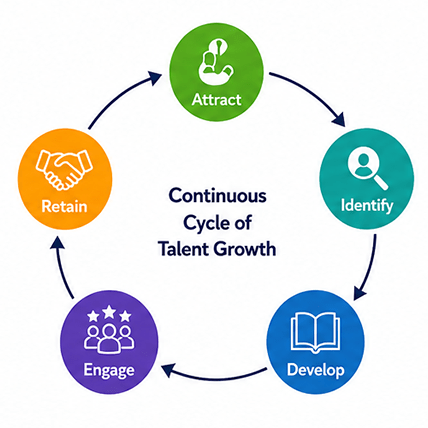
A practical talent management framework can be viewed as six connected stages:
- Attract the capabilities the organization needs.
- Identify employees with valuable performance and potential.
- Develop skills, experience and leadership capability.
- Engage employees through meaningful work and career opportunities.
- Retain critical talent and organizational knowledge.
- Deploy people where their capabilities create the greatest business value.
Succession planning sits within this broader cycle.
It takes the organization’s most important future roles and asks whether the talent pipeline is capable of filling them.
What Is Succession Planning?
Succession planning is the structured process of identifying business-critical positions and preparing people who could potentially take on those responsibilities in the future.
It can involve senior leadership positions, but it should not stop there.
Consider a manufacturing company.
Its managing director is important.
But so is the production manager who understands the plant’s processes, the engineering specialist who knows a critical piece of equipment, the sales director who manages major accounts and the payroll specialist who understands a complex compensation structure.
If any of these people leave, the organization could experience significant disruption.
Modern succession planning therefore focuses increasingly on critical roles rather than job titles alone.
CIPD recommends identifying business-critical roles as an initial step and notes that organizations can also develop talent pools for groups of positions requiring similar capabilities.
Succession planning should also distinguish between immediate replacement and longer-term readiness.
A person might be able to step into an acting role tomorrow but need two years of development before being ready for the full position.
That distinction is crucial.
Succession planning is not replacement planning
There is a major difference between:
Replacement planning:
“Who can take this job if the current employee leaves?”
and:
Succession planning:
“What capabilities will this role require in the future, who could potentially provide them, and what development is necessary to make that possible?”
The second approach is much more strategic.
SHRM describes succession planning as a future-oriented process focused on the knowledge, skills and abilities required for critical functions, with development often taking 12–36 months.
This means succession planning should begin well before the vacancy occurs.
Why Talent Management and Succession Planning Must Work Together
Talent management without succession planning can become disconnected from business continuity.
Succession planning without talent management can become a spreadsheet of names with no real development behind it.
The two disciplines reinforce each other.
Consider this sequence:
Business strategy → Future capabilities → Critical roles → Talent assessment → Development → Successor readiness → Leadership continuity
For example, a company planning to expand into three African markets may need:
- Regional leadership capability
- Cross-border HR expertise
- Financial management skills
- Regulatory knowledge
- Sales leadership
- Digital capabilities
- Cultural intelligence
- International project management
The organization can then assess whether those capabilities already exist internally.
If they do, development plans can be created.
If they don’t, the organization can recruit externally while simultaneously developing internal talent.
This is much more effective than waiting until expansion happens and then discovering that the organization has no leadership bench.
The Business Risks of Ignoring Succession Planning
Succession planning is often postponed because it does not feel urgent.
That is precisely what makes it dangerous.
A vacancy is rarely the actual problem.
The problem is the lack of preparedness behind the vacancy.
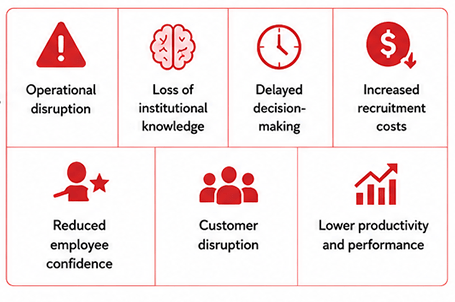
1. Operational disruption
When a critical employee leaves, work that previously depended on their knowledge may suddenly slow down.
Decisions take longer.
Approvals become complicated.
Teams become uncertain about priorities.
Customers may experience delays.
The organization effectively loses momentum while trying to rebuild capability.
2. Loss of institutional knowledge
Some knowledge exists nowhere except inside people’s heads.
A senior employee may know:
- Which suppliers are reliable
- How major customers prefer to communicate
- Which processes regularly fail
- How particular systems actually work
- Which stakeholders require special attention
- Why certain historical decisions were made
Documentation helps, but documentation alone cannot replace experience.
A strong succession programme deliberately transfers knowledge before it becomes vulnerable.
3. Higher recruitment costs
Emergency recruitment is rarely the cheapest form of recruitment.
When a critical position becomes vacant unexpectedly, organizations may have to:
- Pay recruitment fees
- Increase compensation to attract scarce talent
- Accelerate interview processes
- Use temporary leadership
- Relocate employees
- Offer signing incentives
- Spend management time on recruitment
A succession pipeline does not eliminate external recruitment.
It simply reduces the organization’s dependence on emergency hiring.
4. Employee uncertainty
Leadership changes affect more than the departing employee.
Employees may start asking:
“Who is taking over?”
“Is the organization stable?”
“Will our team structure change?”
“Should I start looking elsewhere?”
A planned transition can create confidence.
An improvised transition can create speculation.
5. Customer disruption
Some employees own relationships that are strategically important.
If an account director leaves without a successor or transition plan, customers may suddenly deal with unfamiliar people.
That creates relationship risk.
Succession planning should therefore consider customer-facing roles, not just internal leadership positions.
How to Identify Critical Roles in Your Organization
One of the biggest mistakes organizations make is assuming that the most senior positions are automatically the most critical.
Sometimes they are.
Sometimes they aren’t.
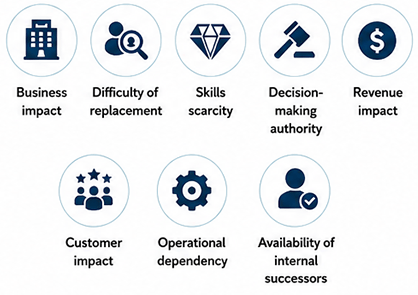
A critical role should be assessed according to its impact on organizational performance.
Consider scoring each role against factors such as:
| Factor | Key Question |
|---|---|
| Business impact | What happens if this role becomes vacant? |
| Revenue impact | Does the role directly influence revenue? |
| Customer impact | Does it manage critical customer relationships? |
| Skills scarcity | How difficult is the capability to find externally? |
| Replacement difficulty | How long would recruitment realistically take? |
| Institutional knowledge | Does the role hold significant organizational knowledge? |
| Decision authority | Can the role materially affect business decisions? |
| Operational dependency | How many processes depend on this position? |
| Regulatory importance | Is the role essential for compliance or licensing? |
| Successor availability | Does the organization already have capable internal talent? |
This creates a more objective approach.
A technical specialist with unique knowledge may score higher than a manager with a larger team.
That is why succession planning should be based on business risk, not hierarchy alone.
High-Potential Employees: Performance Is Not the Same as Potential
This is one of the most important distinctions in talent management.
A high-performing employee is not automatically a future executive.
Someone may be exceptional at their current job but struggle when the job requires:
- Strategic thinking
- Delegation
- Influence
- Ambiguity management
- Cross-functional leadership
- Conflict resolution
- Decision-making with incomplete information
Consider a brilliant sales representative.
They consistently exceed their targets.
Management decides to promote them to sales manager.
Suddenly, their job changes.
They are no longer primarily responsible for selling.
They must coach others, manage performance, allocate resources, resolve disputes and build strategy.
Excellent individual performance does not guarantee leadership capability.
What should organizations assess?
Potential successors can be evaluated across several dimensions:
Performance
- Consistency of results
- Quality of work
- Achievement against objectives
- Reliability
Learning agility
- Ability to learn new concepts
- Response to feedback
- Adaptability
- Curiosity
Leadership capability
- Ability to influence others
- Decision-making
- Communication
- Accountability
Strategic thinking
- Understanding of the broader business
- Ability to connect actions to organizational objectives
- Commercial awareness
Behavioral maturity
- Emotional intelligence
- Resilience
- Integrity
- Collaboration
Career motivation
- Willingness to take on broader responsibility
- Interest in leadership
- Alignment with future opportunities
A succession process should also avoid treating potential as a permanent label.
Someone identified as “high potential” today may not remain the strongest candidate five years from now.
Potential should therefore be reviewed periodically.
Building a Practical Succession Planning Pipeline
A useful succession process does not have to be complicated.
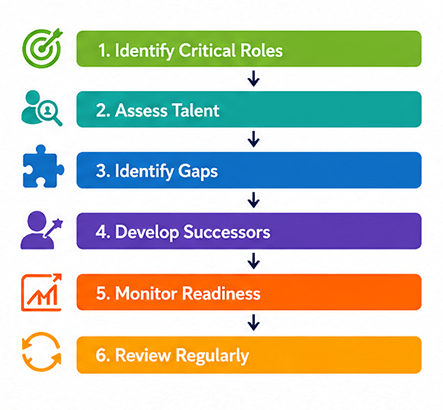
A practical framework is:
Let’s break that down.
Step 1: Identify critical roles
Start with a manageable number.
For example, an organization with 500 employees might initially identify 15–30 roles where vacancy would create significant business risk.
Do not try to create an elaborate plan for every position immediately.
Prioritize.
Step 2: Define future role requirements
Do not assess successors only against what the role requires today.
Ask:
What will this role require three years from now?
If the organization is digitizing operations, the future leader may need stronger technology literacy.
If the business is expanding internationally, cross-border management may become important.
If regulation is changing, compliance capability may become more important.
Succession planning should therefore be linked to strategic workforce planning. CIPD notes that workforce planning should connect organizational goals with people strategy and inform areas including succession planning, recruitment, retention and learning and development.
Step 3: Assess internal talent
Evaluate employees against the future requirements.
Useful inputs can include:
- Performance reviews
- Competency assessments
- 360-degree feedback
- Career discussions
- Psychometric assessments where appropriate
- Manager assessments
- Assessment centres
- Skills inventories
- Past project performance
Avoid relying exclusively on a manager’s personal opinion.
That creates bias and can cause organizations to repeatedly nominate the most visible employees rather than the most capable ones.
Step 4: Identify the talent gap
Suppose a future operations director requires:
- Strategic planning
- Financial management
- Multi-site leadership
- Stakeholder management
- Change management
An internal candidate may have strong operational skills but limited financial exposure.
That does not necessarily eliminate them.
It identifies the development gap.
Step 5: Create an individual development plan
Development should be specific.
Instead of:
“Improve leadership skills.”
Use:
“Lead the cross-functional regional expansion project for six months, receive monthly executive coaching, and present quarterly progress reports to the leadership team.”
That gives the employee real experience.
Step 6: Test readiness
Readiness should be expressed clearly.
For example:
- Ready now
- Ready within 12 months
- Ready within 1–2 years
- Longer-term potential
- Not currently suitable
This is more useful than simply placing someone in a “successor” box.
Step 7: Review regularly
People change.
Businesses change.
Roles change.
Therefore, succession plans should not sit in a confidential HR folder for two years.
Quarterly or semi-annual talent reviews can help organizations reassess:
- Business priorities
- Role requirements
- Employee performance
- Development progress
- Retention risk
- Successor readiness
- External talent availability
Developing Future Leaders: What Actually Works?
One of the weaknesses of many succession programmes is that organizations identify successors but fail to develop them.
A name on a succession chart is not a leadership pipeline.
Development needs to create exposure to the work the person will eventually have to perform.
Coaching
Coaching can help emerging leaders improve decision-making, communication, self-awareness and leadership effectiveness.
It is particularly useful when development needs to be individualized.
Mentoring
A senior leader can transfer organizational knowledge that is difficult to acquire through formal training.
Mentoring can also help employees understand how decisions are made across the organization.
Job rotation
Moving employees across functions can broaden their understanding of the business.
For example:
A finance manager who spends six months working closely with operations may develop stronger commercial and operational understanding.
Stretch assignments
Give employees problems that are slightly beyond their current responsibilities.
Examples include:
- Leading a major project
- Managing a new client
- Presenting to the board
- Opening a new branch
- Managing a cross-functional team
- Leading a process transformation
Stretch assignments provide evidence of capability.
Acting appointments
Temporary leadership assignments can be particularly valuable.
An employee may learn more from acting as a department head for three months than from attending ten leadership seminars.
Cross-functional exposure
Future executives need to understand the organization beyond their own department.
Exposure to:
- Finance
- Operations
- Sales
- HR
- Technology
- Customer service
- Risk
- Strategy
can develop broader business judgment.
CIPD similarly highlights practical work experience, lateral moves and secondments as important components of succession development.
Don’t Build a Leadership Pipeline Only for Executives
Executive succession receives most of the attention.
That can be a mistake.
Organizations also need succession plans for roles such as:
- Plant managers
- Country managers
- Finance controllers
- IT specialists
- Project directors
- Technical engineers
- Sales leaders
- Compliance specialists
- Procurement managers
- Healthcare professionals
- Operations managers
A technical expert may never want to become an executive.
That does not make their development less important.
An organization can create technical career pathways alongside management pathways.
For example:
Engineer → Senior Engineer → Technical Specialist → Principal Engineer
rather than forcing every high-performing technical employee into:
Engineer → Supervisor → Manager
This is important for retention.
Employees should not have to become managers to demonstrate career progression.
Common Succession Planning Mistakes
1. Starting only when someone resigns
If the succession plan begins after the resignation letter arrives, it is not really succession planning.
It is emergency recruitment.
2. Choosing successors based on loyalty
Tenure is valuable, but it is not the same as readiness.
Someone can have worked for the organization for 15 years and still lack the capabilities required for the next role.
3. Assuming the best performer should become the leader
Performance is one input.
Potential, leadership behavior, learning agility and strategic capability also matter.
4. Identifying only one successor
One successor creates another dependency.
If that employee resigns, the organization is back where it started.
For highly critical roles, consider building a broader talent pool where practical.
5. Ignoring external talent
Internal development should not become an ideology.
Sometimes the right successor is outside the organization.
External recruitment can introduce:
- New expertise
- Different perspectives
- Industry experience
- New networks
- New approaches
The objective is not to promote internally at all costs.
The objective is to ensure the organization has access to the capability it needs.
6. Keeping succession completely secret
Confidentiality is important, but excessive secrecy can undermine development.
If employees do not understand their development opportunities, they may not know what capabilities they need to build.
Modern succession approaches increasingly emphasize greater openness, fairness and employee involvement while still protecting sensitive information.
7. Treating succession planning as an HR-only responsibility
HR can design and facilitate the process.
But business leaders need to own the outcomes.
A CEO, CFO, COO or business-unit leader should be able to answer:
“If this critical person leaves tomorrow, what is our plan?”
If only HR knows the answer, the organization has a governance problem.
How to Measure Succession Planning Success
What gets measured tends to receive attention.
Organizations can track several indicators.
Critical role coverage
Percentage of critical roles with at least one identified successor.
This shows whether the organization has actually mapped its exposure.
Successor readiness
Measure how many successors are:
- Ready now
- Ready within 12 months
- Ready within 1–2 years
- Longer-term prospects
This gives leadership a much clearer view of bench strength.
Internal promotion rate
A strong internal pipeline should create opportunities for capable employees to progress.
Internal mobility
Track movement across functions, business units and levels.
High-potential retention
If high-potential employees consistently leave, the organization should ask why.
Possible reasons include:
- Limited career opportunities
- Poor management
- Inadequate development
- Compensation issues
- Lack of recognition
- Unclear career pathways
Time to fill critical roles
Compare the time required to fill critical positions before and after implementing succession planning.
Leadership bench strength
One useful question is:
“How many roles could we fill internally if a critical vacancy occurred tomorrow?”
That number can become a meaningful strategic metric.
Connecting Succession Planning to Business Strategy
The strongest succession programmes do not start with an HR spreadsheet.
They start with business strategy.
Imagine a company plans to expand from Kenya into Tanzania, Uganda, Rwanda and Ghana.
Its leadership requirements may change significantly.
The organization might need people who understand:
- Regional operations
- Cross-border employment
- Local regulations
- Market development
- Multicultural leadership
- International finance
- Regional supply chains
That should influence its talent strategy today.
Similarly, a company investing heavily in AI and automation may need leaders with stronger digital literacy.
A manufacturing company expanding production capacity may need additional technical and operational leadership.
A healthcare organization entering new markets may need leaders who understand both clinical operations and regulatory requirements.
The question is therefore not simply:
“Who can replace our current leaders?”
It is:
“What kind of leadership will the business need next?”
That is the point where succession planning becomes a strategic capability rather than an administrative HR process.
Talent Management and Succession Planning in Africa’s Growing Organizations
For organizations operating across African markets, succession planning can be particularly important because growth often creates leadership requirements faster than internal structures develop.
A business may open a new country office and suddenly need:
- A country manager
- HR leadership
- Finance leadership
- Operations management
- Sales leadership
- Compliance expertise
Recruiting all of these capabilities externally can be expensive and slow.
A stronger approach is to develop regional talent pools alongside external recruitment.
For example, a high-performing manager in Kenya could receive cross-border exposure before being considered for a regional position.
A finance manager in Uganda could participate in a group-wide project.
An HR professional in Tanzania could take responsibility for a regional HR initiative.
These experiences create leadership capability while strengthening organizational knowledge across markets.
The principle is simple:
Build talent before the business urgently needs it.
How Technology Can Support Talent Management and Succession Planning
Technology can make succession planning easier to manage, particularly as organizations grow.
A structured HR or talent management platform can help organizations maintain information about:
- Employee skills
- Performance
- Career aspirations
- Development plans
- Training
- Competencies
- Critical roles
- Successor readiness
- Internal mobility
Technology can also make talent reviews more consistent.
However, technology should support judgment rather than replace it.
A dashboard can tell you that an employee achieved excellent performance scores.
It cannot automatically determine whether that person can successfully lead a business unit through a crisis.
Human assessment remains essential.
Organizations should also be careful about algorithmic bias when using AI-supported talent assessment tools.
Any technology used for talent decisions should be evaluated for:
- Data quality
- Transparency
- Fairness
- Privacy
- Bias
- Explainability
- Appropriate human oversight
The objective is better decision-making, not simply more data.
A Practical 90-Day Approach to Starting Succession Planning
Organizations do not need to build a perfect succession programme before taking the first step.
A practical starting point can be completed in 90 days.
Days 1–30: Identify risk
Bring together senior leadership and HR.
Identify:
- 10–20 critical roles
- Current role holders
- Key responsibilities
- Business impact
- Replacement difficulty
- Skills required
- Immediate vulnerabilities
The goal is to understand where the organization is exposed.
Days 31–60: Assess talent
Identify internal employees who could potentially fill those roles.
Assess:
- Performance
- Potential
- Skills
- Leadership capability
- Experience
- Career aspirations
- Development gaps
Do not promise promotions.
The objective is to understand readiness.
Days 61–90: Build development plans
For each priority successor, define specific development actions.
For example:
Successor: Operations Manager
Target role: Regional Operations Director
Current readiness: 18–24 months
Development gaps: Financial management, regional exposure, strategic planning
Actions: Executive coaching, regional project leadership, finance rotation, quarterly executive presentations
Now the succession plan becomes actionable.
A Simple Succession Planning Framework for HR Leaders
An organization can structure its process around seven questions:
1. What roles are critical?
Identify positions where vacancy would materially affect business performance.
2. What will those roles require in the future?
Don’t assess tomorrow’s leaders against yesterday’s job descriptions.
3. Who has potential?
Use objective evidence rather than personal preference.
4. What capability gaps exist?
Identify what each potential successor still needs to learn.
5. How will those gaps be closed?
Create practical development experiences.
6. How ready is each successor?
Use clear readiness categories.
7. What happens if the person leaves tomorrow?
Create an emergency continuity plan as well as a long-term succession plan.
This last question is often overlooked.
Long-term succession planning and emergency replacement planning should complement each other.
The Future of Succession Planning Is Skills-Based
Organizations are increasingly moving away from thinking exclusively in terms of job titles.
Instead, they are beginning to think in terms of skills and capabilities.
This matters because jobs evolve.
A role that exists today may look very different in three years.
The World Economic Forum’s 2025 research highlights the scale of this shift, with employers expecting 39% of existing skill sets to change by 2030. It also identifies leadership and social influence, analytical thinking, resilience, flexibility and agility, alongside technology-related capabilities, among skills rising in importance.
This creates an important implication for succession planning:
The best successor may not look exactly like the current job holder.
Instead of asking:
“Who is most similar to our current director?”
ask:
“Who can develop the capabilities our future director will need?”
That subtle change can significantly improve talent decisions.
It also makes internal mobility more valuable.
An employee from another function may possess transferable capabilities that make them a stronger future leader than someone who follows the traditional career path.
Talent Management Should Answer the Question: “What Happens Next?”
A strong talent management strategy should give employees a sense of direction.
It should help answer:
- What can I become here?
- What skills do I need?
- What experiences should I gain?
- What opportunities are available?
- How will my performance be evaluated?
- What does leadership potential look like?
- How can I move across the organization?
For employers, it answers a different but equally important set of questions:
- Who are our critical people?
- Which capabilities are scarce?
- Where are our talent gaps?
- Who could become future leaders?
- Where are we overly dependent on individuals?
- Which roles are most vulnerable?
- What capabilities will we need in three to five years?
That is why talent management should not be treated simply as an employee development programme.
It is a business capability.
Is Your Organization Ready for Its Next Critical Vacancy?
Every organization has people it cannot easily replace.
The risk is not necessarily that those employees will leave.
The risk is that the organization has no plan if they do.
Effective talent management and succession planning changes that equation.
It creates visibility into critical roles, identifies emerging talent, exposes capability gaps and gives future leaders the experiences they need before the organization urgently needs them.
It also changes how HR contributes to business strategy.
Instead of reacting to vacancies, HR can help leadership anticipate capability requirements.
Instead of asking who should replace someone, the organization can ask what the future role actually requires.
Instead of waiting for high performers to become disengaged, organizations can create meaningful development and career pathways.
And instead of relying on a handful of indispensable employees, businesses can deliberately build organizational depth.
The strongest succession plans are therefore not really about replacing people.
They are about making the organization less dependent on individual people while becoming more capable because of the people it develops.
If your organization has critical roles with no clear successor, high-potential employees without structured development plans, or leadership positions that would be difficult to fill quickly, that is a talent risk worth addressing now—not when the vacancy appears.
Build your organization’s future leadership pipeline
Talent Grid Africa can help organizations assess critical roles, identify talent gaps, strengthen leadership pipelines and develop practical talent management and succession planning strategies.
CTA: Schedule a Talent Management & Succession Planning Consultation to identify critical talent, strengthen your leadership pipeline and build greater workforce resilience before the need arises.