Leadership has become one of the strongest competitive advantages an organization can possess. While businesses often invest heavily in technology, marketing, and operations, many overlook the factor that determines whether those investments deliver meaningful results: the quality of leadership.
Markets evolve. Customer expectations shift. Employees seek purpose alongside competitive compensation. New technologies transform how work is done. Through all these changes, organizations depend on leaders who can make sound decisions, inspire people, and guide teams with confidence.
Strong leadership is no longer reserved for executives in the boardroom. It exists at every level of an organization, from frontline supervisors and department managers to senior executives and future leaders preparing for greater responsibilities.
This is where leadership development becomes essential.
Organizations that deliberately build leadership capabilities create resilient teams, improve employee engagement, strengthen succession planning, and position themselves for sustainable growth. Those that neglect leadership development often face high turnover, inconsistent decision-making, declining morale, and stalled business performance.
Rather than treating leadership as a natural talent that only a few possess, successful organizations recognize that leadership is a skill that can be cultivated through continuous learning, coaching, practical experience, and intentional development.
This guide explores why leadership development deserves strategic priority, how it impacts organizational success, and what businesses can do to develop leaders capable of navigating today’s challenges and tomorrow’s opportunities.
What Is Leadership Development?
Leadership development refers to the continuous process of improving an individual’s ability to lead people, manage change, solve problems, communicate effectively, and drive organizational success.
Unlike one-off training sessions, leadership development is an ongoing investment that combines learning, practical experience, mentoring, coaching, and feedback to strengthen leadership capabilities over time.
The objective extends far beyond preparing someone for a management position. Effective leadership development equips individuals to:
- Inspire teams toward shared goals
- Make informed strategic decisions
- Navigate uncertainty with confidence
- Build trust across departments
- Foster innovation
- Develop future leaders
- Create positive organizational cultures
Leadership development therefore becomes a long-term organizational capability rather than a short-term training initiative.
Leadership Development Is About Influence, Not Authority
Many people assume leadership begins when someone receives a promotion. In reality, leadership begins when individuals influence positive outcomes regardless of their job title.
Consider two employees.
The first supervises twenty people but rarely communicates expectations clearly, avoids difficult conversations, and struggles to motivate the team.
The second has no formal management responsibilities but consistently mentors colleagues, solves problems proactively, earns trust, and helps others succeed.
Who demonstrates stronger leadership?
Most organizations would identify the second individual as displaying greater leadership potential.
This illustrates why leadership development should start before employees enter formal management positions.
Developing leadership early allows organizations to create stronger succession pipelines while reducing the risks associated with promoting technically skilled employees who may lack people leadership capabilities.
Leadership Is Learned, Not Born
The idea that great leaders are simply “born that way” has gradually been replaced by decades of research showing that effective leadership can be developed.
While personality traits may influence leadership style, critical leadership competencies are learned through experience and intentional practice.
These include:
- Communication
- Strategic thinking
- Emotional intelligence
- Decision-making
- Conflict resolution
- Coaching
- Delegation
- Accountability
- Change management
Like any professional skill, these abilities improve with structured learning and practical application.
Organizations that recognize this shift invest consistently in helping employees grow into capable leaders rather than waiting for leadership talent to emerge naturally.
Leadership vs. Management: Understanding the Difference
Leadership and management are closely connected, yet they serve different purposes.
Many professionals use the terms interchangeably, but understanding their distinctions is essential when designing effective leadership development programs.
What Is Management?
Management focuses on planning, organizing, coordinating resources, and ensuring work gets completed efficiently.
Managers typically oversee:
- Budgets
- Processes
- Schedules
- Performance targets
- Resource allocation
- Operational efficiency
Good management creates consistency.
It answers questions such as:
- What needs to be done?
- Who will complete the work?
- When should it be delivered?
- How should performance be measured?
Management ensures the organization operates smoothly.
What Is Leadership?
Leadership focuses on influencing people rather than controlling processes.
Leaders help employees understand:
- Why their work matters
- Where the organization is heading
- How to overcome challenges
- How to embrace change
- How to perform beyond expectations
Leadership builds commitment rather than simple compliance.
Instead of directing people solely through authority, leaders inspire trust, purpose, and collaboration.
A Practical Example
Imagine a company implementing a new customer relationship management (CRM) system.
A manager might:
- Develop implementation timelines
- Assign responsibilities
- Track project milestones
- Ensure deadlines are met
A leader, however, would also:
- Explain why the change matters
- Address employee concerns
- Build enthusiasm around the transition
- Encourage collaboration
- Help teams adapt confidently
The most successful organizations combine excellent management with strong leadership.
Processes keep the business running.
Leadership moves the business forward.
Why Businesses Need Both
Organizations often promote high-performing technical employees into management roles without preparing them for leadership responsibilities.
A brilliant engineer may become an engineering manager.
A skilled salesperson may become a sales director.
An exceptional accountant may become a finance manager.
Technical expertise alone rarely guarantees leadership success.
Without leadership development, these professionals may struggle with:
- Managing people
- Delegating work
- Giving constructive feedback
- Resolving conflict
- Motivating diverse teams
- Driving organizational change
This explains why leadership development should accompany career progression rather than follow it.
Why Leadership Development Matters
Organizations rarely outperform the quality of their leadership for long.
When leaders improve, teams improve.
When teams improve, organizational performance follows.
Leadership development influences virtually every aspect of business success.
Better Business Performance
Effective leaders align people with organizational goals.
Rather than simply assigning tasks, they help employees understand how individual contributions support broader business objectives.
This clarity creates stronger accountability and higher levels of performance.
Organizations with well-developed leaders often experience:
- Higher productivity
- Better customer service
- Improved collaboration
- Faster decision-making
- Greater operational efficiency
Employees who understand the “why” behind their work tend to demonstrate greater commitment than those who only receive instructions.
Higher Employee Engagement
One of the strongest predictors of employee engagement is the quality of immediate leadership.
Employees frequently remain with organizations because of supportive leaders—or leave because of ineffective ones.
Strong leaders create environments where employees feel:
- Valued
- Trusted
- Supported
- Challenged
- Recognized
- Heard
These factors significantly influence motivation and discretionary effort.
Conversely, poor leadership often leads to disengagement, absenteeism, and declining morale.
Leadership development equips managers with the interpersonal skills necessary to foster positive employee experiences.
Stronger Organizational Culture
Culture is shaped less by corporate values displayed on office walls and more by the daily behaviors demonstrated by leaders.
Employees observe how leaders:
- Handle conflict
- Make decisions
- Communicate
- Reward performance
- Respond to failure
- Support collaboration
These behaviors establish organizational norms.
Leadership development helps ensure leaders consistently model the values organizations want employees to embrace.
Improved Innovation
Innovation thrives where employees feel psychologically safe.
Teams are more likely to:
- Share ideas
- Experiment
- Learn from mistakes
- Challenge assumptions
- Collaborate openly
when leaders encourage curiosity rather than punish failure.
Leadership development strengthens the coaching and communication skills required to create innovative workplaces.
Organizations seeking digital transformation or continuous improvement cannot rely solely on technology—they also need leaders capable of guiding people through change.
Greater Organizational Agility
Business priorities change rapidly.
Market disruptions, economic uncertainty, technological advances, and changing workforce expectations require organizations to adapt continuously.
Leaders who can communicate effectively during uncertainty help organizations remain resilient.
Leadership development builds capabilities in:
- Change leadership
- Crisis management
- Strategic thinking
- Decision-making under pressure
- Stakeholder communication
These competencies become increasingly valuable during periods of transformation.
Why Organizations Need Strong Leaders
Leadership affects every employee, customer, and stakeholder.
Whether an organization employs twenty people or twenty thousand, leadership quality directly influences its ability to achieve strategic objectives.
The strongest organizations intentionally develop leaders because they recognize leadership drives long-term business performance rather than simply supporting it.
Leaders Drive Business Performance
Every strategic initiative ultimately depends on execution.
A brilliant business strategy has little value if leaders cannot translate it into action.
Strong leaders help teams:
- Prioritize effectively
- Maintain focus
- Overcome obstacles
- Stay accountable
- Deliver consistent results
For example, two organizations may implement identical growth strategies. The organization with leaders who communicate clearly, engage employees, and respond effectively to challenges is far more likely to achieve successful execution.
Leadership transforms strategy from a document into measurable business outcomes.
Strong Leaders Build Highly Engaged Employees
Organizations invest significant resources in attracting top talent, yet retaining that talent depends largely on leadership.
While compensation, benefits, and career opportunities matter, employees often evaluate their workplace experience through their direct manager. A supportive, competent leader can transform an average workplace into a motivating environment, while poor leadership can drive even high-performing employees to seek opportunities elsewhere.
Research consistently shows that engaged employees are more likely to:
- Deliver higher-quality work
- Provide better customer service
- Collaborate effectively with colleagues
- Stay with the organization longer
- Contribute innovative ideas
- Act as ambassadors for the employer brand
Leadership plays a central role in creating this engagement.
High-performing leaders don’t simply assign work, they create clarity, recognize achievements, provide constructive feedback, and invest in their team’s growth.
Example
Imagine two sales managers overseeing teams with similar experience and targets.
Manager A focuses solely on monthly numbers, offering little feedback beyond performance reports.
Manager B holds regular coaching sessions, celebrates milestones, helps team members overcome challenges, and encourages professional development.
Although both teams may begin with similar capabilities, over time Manager B’s team is far more likely to demonstrate stronger morale, higher productivity, and lower turnover.
This illustrates a simple truth: people don’t just work for organizations—they work for leaders.
Strong Leadership Drives Innovation
Innovation isn’t limited to launching new products or adopting advanced technologies. It also includes improving processes, enhancing customer experiences, solving operational challenges, and finding better ways of working.
Employees are more willing to share ideas when they believe their opinions are valued.
Effective leaders cultivate environments where people feel comfortable:
- Asking questions
- Challenging assumptions respectfully
- Suggesting improvements
- Learning from mistakes
- Collaborating across departments
Conversely, workplaces dominated by fear or excessive micromanagement often discourage creativity.
When employees worry about criticism or failure, they naturally become more cautious and less innovative.
Leadership development helps managers transition from controlling every detail to empowering their teams.
Leadership Shapes Organizational Culture
Culture is often described as “how things are done around here.”
While organizations may publish mission statements and values, employees pay closer attention to the behaviors demonstrated by leaders every day.
Consider how leaders influence culture through:
Communication
Transparent leaders build trust.
Employees are more likely to support organizational changes when leaders explain the reasoning behind decisions and communicate openly during uncertainty.
Accountability
Leaders who hold themselves accountable encourage others to do the same.
Accountability creates fairness, strengthens performance standards, and builds credibility.
Recognition
Simple acts of appreciation can significantly influence employee motivation.
Recognizing achievements, both large and small reinforces desired behaviors and contributes to a positive workplace culture.
Inclusion
Leaders who encourage diverse perspectives create stronger teams capable of making better decisions.
Inclusive leadership also improves employee belonging and strengthens organizational reputation.
Culture isn’t created by policy documents.
It’s created by consistent leadership behaviors.
Leadership Strengthens Organizational Resilience
Every organization will eventually face disruption.
Economic uncertainty.
Market shifts.
Technological advances.
Talent shortages.
Unexpected crises.
The differentiating factor isn’t whether challenges arise it’s how leaders respond.
Strong leaders provide stability during uncertainty by:
- Remaining calm under pressure
- Making informed decisions with limited information
- Communicating honestly
- Maintaining employee confidence
- Adapting strategies quickly
Organizations that invest in leadership development are better prepared to navigate uncertainty because they have leaders capable of responding effectively rather than reacting emotionally.
The Cost of Neglecting Leadership Development
While the benefits of leadership development are significant, the consequences of ignoring it can be even more costly.
Poor leadership rarely affects just one department it impacts productivity, employee experience, customer satisfaction, financial performance, and organizational reputation.
Many businesses recognize these problems only after they begin losing valuable employees or struggling to execute strategic initiatives.
Let’s examine the hidden costs.
High Employee Turnover
One of the clearest indicators of poor leadership is frequent employee turnover.
Replacing employees is expensive.
Organizations incur costs related to:
- Recruitment
- Advertising vacancies
- Interviewing candidates
- Onboarding
- Training
- Lost productivity
- Knowledge transfer
Beyond financial costs, frequent departures disrupt team dynamics and reduce organizational stability.
Employees are far more likely to remain where they feel supported, challenged, and respected.
Leadership development equips managers with the interpersonal skills needed to create environments where people want to stay.
Weak Succession Planning
Organizations often encounter unexpected leadership gaps due to:
- Retirement
- Promotions
- Resignations
- Organizational restructuring
- Business expansion
Without a leadership pipeline, filling these positions becomes reactive rather than strategic.
External recruitment can certainly bring valuable expertise, but relying exclusively on external hires may:
- Increase recruitment costs
- Extend hiring timelines
- Delay strategic initiatives
- Reduce employee morale if internal growth opportunities appear limited
Leadership development helps organizations identify high-potential employees early and prepare them for future leadership responsibilities.
Succession planning becomes proactive rather than emergency-driven.
Declining Employee Morale
Poor leadership affects workplace atmosphere almost immediately.
Employees become disengaged when they experience:
- Inconsistent communication
- Lack of recognition
- Unclear expectations
- Limited career development
- Unfair decision-making
- Micromanagement
Over time, these issues contribute to frustration, reduced collaboration, and declining organizational commitment.
Conversely, effective leadership creates workplaces where employees feel motivated to contribute beyond minimum expectations.
Reduced Productivity
Productivity problems aren’t always caused by inadequate employee skills.
Sometimes the issue lies in leadership.
Poor leaders often create bottlenecks by:
- Delaying decisions
- Providing unclear direction
- Avoiding difficult conversations
- Failing to delegate
- Constantly changing priorities
Employees spend more time seeking clarification than delivering meaningful work.
Leadership development helps managers improve planning, delegation, communication, and decision-making—allowing teams to operate more efficiently.
Leadership Gaps During Growth
Business growth creates new leadership demands.
As organizations expand, leaders must manage:
- Larger teams
- Multiple locations
- Cross-functional collaboration
- More complex decision-making
- Increased stakeholder expectations
Without ongoing leadership development, organizations may outgrow the capabilities of their current leaders.
The result can include:
- Operational inefficiencies
- Inconsistent customer experiences
- Slower decision-making
- Reduced employee engagement
Developing leadership capacity alongside business growth helps organizations scale more effectively.
Customer Experience Suffers
Leadership influences customer experience more than many organizations realize.
Employees who feel engaged and supported are generally more likely to:
- Deliver excellent service
- Resolve issues proactively
- Represent the organization positively
- Build stronger customer relationships
Poor leadership, however, often creates disengaged employees whose lack of motivation becomes visible to customers.
Strong leadership therefore improves not only internal performance but also external reputation.
Characteristics of High-Impact Leaders
Leadership titles alone do not determine influence.
The most respected leaders consistently demonstrate behaviors that inspire confidence, encourage collaboration, and drive results.
While leadership styles vary, high-impact leaders typically share several core characteristics.
Emotional Intelligence
Technical expertise may earn promotions.
Emotional intelligence earns trust.
Leaders with strong emotional intelligence understand both their own emotions and those of others.
They demonstrate:
- Self-awareness
- Empathy
- Emotional regulation
- Active listening
- Relationship management
When conflicts arise, emotionally intelligent leaders seek understanding before reacting.
This creates healthier workplace relationships and more effective collaboration.
Strategic Thinking
Effective leaders balance immediate operational priorities with long-term organizational goals.
Rather than focusing solely on today’s challenges, they consider:
- Future market trends
- Business opportunities
- Workforce capabilities
- Organizational risks
- Competitive positioning
Strategic thinking enables leaders to make decisions that support sustainable growth rather than short-term gains.
Exceptional Communication
Communication remains one of the most valuable leadership skills.
Strong leaders communicate with clarity, consistency, and authenticity.
They know how to:
- Explain complex ideas simply
- Provide constructive feedback
- Listen actively
- Inspire confidence
- Manage difficult conversations
- Align teams around shared objectives
Communication is not merely about speaking, it is equally about listening.
Employees who feel heard are more likely to remain engaged and committed.
Decisive Yet Adaptable
Leadership often requires making decisions with incomplete information.
High-impact leaders avoid paralysis.
Instead, they:
- Gather available evidence
- Consult relevant stakeholders
- Evaluate risks
- Make timely decisions
- Adjust course when new information emerges
Adaptability has become increasingly important as organizations navigate changing technologies, workforce expectations, and economic conditions.
Coaches Rather Than Controllers
Traditional leadership often emphasized supervision.
Modern leadership emphasizes development.
High-impact leaders view themselves as coaches who help employees unlock their potential.
They regularly:
- Ask thoughtful questions
- Provide constructive feedback
- Encourage independent thinking
- Support career growth
- Celebrate progress
Rather than solving every problem themselves, they develop employees who can solve problems independently.
This strengthens both individual capability and organizational resilience.
Integrity and Accountability
Trust is built through consistency.
Employees follow leaders whose actions align with their words.
High-impact leaders:
- Accept responsibility for mistakes
- Demonstrate ethical decision-making
- Honor commitments
- Treat employees fairly
- Lead by example
Integrity creates credibility and credibility is the foundation of effective leadership.
Building an Effective Leadership Development Strategy
Leadership development should never be viewed as a standalone HR initiative or an occasional training event. The organizations that consistently produce capable leaders treat leadership development as a long-term business strategy aligned with organizational goals.
A well-designed strategy ensures that leadership capability grows alongside the business, enabling organizations to adapt to change, retain top talent, and execute their vision effectively.
The following pillars form the foundation of a successful leadership development strategy.
1. Identify Leadership Competencies
Every organization should begin by defining what effective leadership looks like within its unique context.
While many leadership qualities are universal, the competencies required in a fast-growing technology company may differ from those needed in a manufacturing business, healthcare institution, or nonprofit organization.
Developing a leadership competency framework helps create consistency in recruitment, performance management, succession planning, and professional development.
Typical leadership competencies include:
- Strategic thinking
- Emotional intelligence
- Effective communication
- Decision-making
- Problem-solving
- Accountability
- Change management
- Team leadership
- Coaching and mentoring
- Customer-centric thinking
Clearly defined competencies also provide employees with a roadmap for career progression.
2. Assess Current Leadership Capabilities
Before investing in leadership development initiatives, organizations need to understand their current strengths and development gaps.
Leadership assessments provide valuable insights into areas where managers and future leaders may need additional support.
Common assessment methods include:
360-Degree Feedback
This approach gathers confidential feedback from supervisors, peers, direct reports, and sometimes customers to provide a balanced view of leadership effectiveness.
Personality and Behavioral Assessments
Tools such as DISC, Myers-Briggs (MBTI), CliftonStrengths, or Hogan Assessments can help leaders better understand their communication styles, strengths, and potential blind spots. These tools are most effective when combined with coaching rather than used in isolation.
Leadership Competency Assessments
Organizations can evaluate leaders against predefined competencies through structured interviews, observation, simulations, or assessment centers.
Employee Engagement Surveys
Employee feedback often highlights leadership strengths and recurring challenges that formal evaluations may overlook.
The goal of assessment is not to judge leaders, it is to identify opportunities for growth and tailor development plans accordingly.
3. Invest in Leadership Training and Coaching
Leadership skills are developed through a combination of knowledge, practice, reflection, and feedback.
A comprehensive leadership development program should combine multiple learning methods rather than relying solely on classroom training.
Effective learning approaches include:
Leadership Workshops
Interactive workshops help leaders develop practical skills such as:
- Managing difficult conversations
- Delegation
- Performance management
- Strategic planning
- Negotiation
- Conflict resolution
- Leading change
Executive Coaching
One-on-one coaching provides personalized guidance, helping leaders improve self-awareness, overcome challenges, and strengthen decision-making.
Executive coaching is particularly valuable for senior leaders managing complex responsibilities.
Action Learning Projects
Adults learn best through real-world application.
Assigning cross-functional projects enables emerging leaders to practice collaboration, problem-solving, and strategic thinking while delivering measurable business outcomes.
Microlearning
Short, focused learning modules delivered regularly can reinforce leadership concepts without disrupting daily operations.
This approach supports continuous learning and knowledge retention.
4. Establish Mentorship Programmes
Mentorship is one of the most effective and often underutilized leadership development tools.
Experienced leaders possess valuable institutional knowledge that cannot always be captured in formal training.
A structured mentorship programme enables emerging leaders to:
- Learn from practical experience
- Build confidence
- Navigate workplace challenges
- Expand professional networks
- Develop strategic perspectives
Successful mentorship programmes typically include:
- Clearly defined objectives
- Regular mentor-mentee meetings
- Confidential discussions
- Goal setting
- Progress reviews
Mentorship also benefits experienced leaders by strengthening their coaching skills and reinforcing a culture of continuous learning.
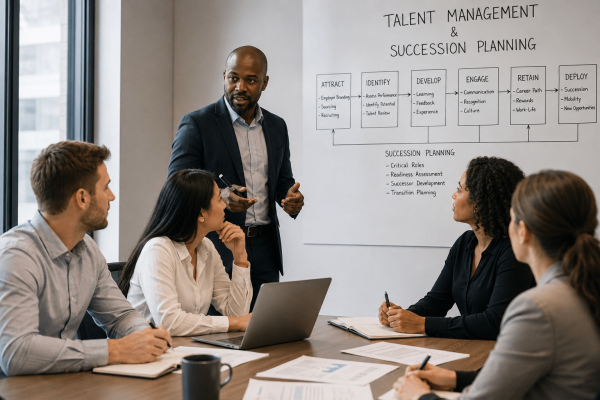
5. Integrate Leadership Development into Succession Planning
Leadership development and succession planning should work hand in hand.
Organizations should avoid waiting until a leadership vacancy arises before identifying potential successors.
Instead, they should proactively identify high-potential employees and provide them with development opportunities aligned with future leadership roles.
A strong succession planning process typically includes:
- Identifying critical positions
- Assessing leadership potential
- Creating individual development plans
- Assigning stretch assignments
- Providing mentoring and coaching
- Reviewing talent regularly
This approach minimizes disruption when leadership transitions occur and strengthens organizational resilience.
6. Foster a Culture of Continuous Learning
Leadership development is not a destination it is an ongoing journey.
The most successful organizations encourage leaders to continuously expand their knowledge through:
- Industry conferences
- Professional certifications
- Leadership books and podcasts
- Peer learning groups
- Online learning platforms
- Cross-functional projects
Continuous learning helps leaders remain adaptable in an increasingly dynamic business environment.
It also signals that leadership growth is a long-term organizational priority rather than a one-time initiative.
Measuring Leadership Development Success
Leadership development should be evaluated with the same level of rigor as any other strategic business investment.
Measuring outcomes helps organizations refine programmes, demonstrate return on investment (ROI), and ensure leadership initiatives contribute to business objectives.
Key metrics include:
Employee Engagement
Improved leadership often leads to higher engagement scores.
Organizations should monitor:
- Employee satisfaction
- Trust in leadership
- Communication effectiveness
- Recognition
- Career development opportunities
Team Performance
Leadership effectiveness should translate into measurable improvements in team outcomes.
Indicators may include:
- Productivity
- Goal achievement
- Project completion rates
- Customer satisfaction
- Quality of work
Internal Promotion Rates
An increasing number of leadership positions filled internally indicates that development programmes are successfully preparing future leaders.
Internal promotions also reduce recruitment costs and strengthen employee retention.
Retention of High-Potential Employees
Leadership development creates visible career pathways.
Employees who see opportunities for growth are more likely to remain with the organization.
Monitoring retention among high-performing employees provides valuable insight into programme effectiveness.
Leadership Readiness
Organizations should regularly assess whether potential successors are prepared to assume leadership responsibilities.
Leadership readiness can be evaluated through:
- Performance reviews
- Assessment centres
- Stretch assignments
- Leadership simulations
- Development milestones
Business Outcomes
Ultimately, leadership development should contribute to broader organizational goals, including:
- Revenue growth
- Improved operational efficiency
- Innovation
- Customer satisfaction
- Organizational resilience
- Employer brand strength
Leadership development should not be viewed as a cost—it is an investment in sustainable business performance.
Best Practices for Sustainable Leadership Development
Organizations that build strong leadership pipelines tend to follow several common practices:
- Align leadership development with business strategy.
- Secure visible support from senior executives.
- Start developing leaders early, not only after promotions.
- Blend formal learning with practical experience.
- Encourage mentoring and peer learning.
- Provide regular feedback and coaching.
- Measure outcomes and adjust programmes based on results.
- Promote diversity and inclusion within leadership pipelines.
- Celebrate leadership growth and success stories.
- Reinforce learning through continuous development opportunities.
Leadership development is most effective when it becomes part of the organization’s culture rather than a standalone programme.
Final Thoughts
Organizations rarely achieve sustainable growth by chance. Behind every resilient business, engaged workforce, and successful transformation is a team of leaders capable of inspiring people, making sound decisions, and adapting to change.
Leadership development is not simply about preparing individuals for management roles rather it’s about building the capability to guide teams through uncertainty, cultivate innovation, and create cultures where people and businesses thrive together.
The organizations that consistently invest in developing leaders are also the ones best positioned to attract top talent, retain high-performing employees, strengthen succession pipelines, and respond confidently to changing market demands.
Whether your business is preparing future managers, strengthening executive leadership, or creating a long-term succession strategy, investing in leadership development today is an investment in tomorrow’s performance.
Build the Leaders Your Business Needs for Tomorrow
Leadership challenges rarely solve themselves, and waiting until a leadership gap appears can be costly. A proactive approach ensures your organization has the right people, skills, and leadership pipeline to support future growth.
At Talent Grid Africa Limited, we partner with organizations across Africa to design practical leadership development solutions that align with business strategy. From leadership assessments and management training to succession planning and executive coaching, our programs help organizations build confident, capable leaders who deliver measurable results.
Ready to strengthen your leadership pipeline?