Introduction: The Hidden Risk Most Organizations Ignore
Most organizations don’t collapse because of competition they collapse because of leadership gaps they never prepared for.
A CEO resigns unexpectedly. A department head retires earlier than planned. A high-performing manager leaves for a better opportunity. Suddenly, decision-making slows, teams lose direction, and business momentum weakens.
What was once a stable organization begins reacting instead of leading.
This is the silent cost of poor planning.
Yet, leadership transitions are not surprises they are predictable events happening inside unpredictable timelines.
That is exactly why leadership development and succession planning is not an HR formality. It is a strategic system that determines whether a business grows smoothly or constantly struggles with leadership disruption.
Organizations that master this do three things differently:
- They intentionally build leaders before they need them
- They treat talent as a pipeline, not a pool
- They plan for continuity, not replacement
Let’s break down how this actually works in practice.
What is Leadership Development and Succession Planning?
Leadership Development
Leadership development refers to the intentional process of improving the skills, competencies, mindset, and capabilities of current and future leaders within an organization. It focuses on preparing individuals to lead teams, make decisions, manage complexity, and drive organizational goals.
It includes:
- Coaching and mentoring programs
- Leadership training workshops
- On-the-job development assignments
- Emotional intelligence development
- Strategic thinking enhancement
Succession Planning
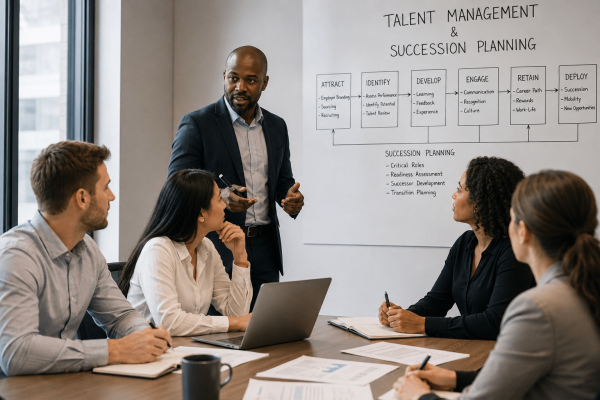
Succession planning is the structured process of identifying and preparing individuals to fill key roles when they become vacant. It ensures business continuity by reducing leadership gaps and ensuring smooth transitions.
It involves:
- Identifying critical roles
- Mapping potential successors
- Assessing readiness levels
- Developing transition plans
- Building leadership pipelines
How They Work Together
Leadership development builds capability. Succession planning applies that capability strategically.
One without the other creates imbalance:
- Development without succession planning leads to skilled employees without clear progression.
- Succession planning without development leads to identified successors who are unprepared.
Together, they create a future-ready organization.
Why Leadership Development and Succession Planning Matter
Organizations that invest in leadership continuity outperform those that don’t especially in volatile or rapidly changing industries.
Here’s why this strategy is critical:
1. Business Continuity and Stability
Leadership transitions are inevitable. Retirement, promotions, resignations, or unexpected departures can disrupt operations.
Without a succession plan:
- Decision-making slows down
- Teams lose direction
- Projects stall
- Clients lose confidence
With a structured plan, transitions become seamless rather than disruptive.
2. Talent Retention and Employee Motivation
Employees are more likely to stay when they see a clear growth path.
When organizations invest in leadership development:
- Employees feel valued
- Internal mobility increases
- Engagement improves
- Turnover reduces significantly
People don’t leave companies they leave unclear futures.
3. Reduced Recruitment Costs
External hiring for leadership roles is expensive and risky. Internal succession reduces:
- Hiring costs
- Onboarding time
- Cultural misalignment risks
Internal candidates already understand the organization’s values, systems, and culture.
4. Stronger Organizational Culture
Leadership shapes culture more than policies do. When leaders are developed internally, they preserve and strengthen organizational identity.
5. Competitive Advantage
Organizations with strong leadership pipelines adapt faster, innovate more effectively, and respond better to market changes.
Leadership Development vs Succession Planning: Key Differences
Although closely related, these two concepts serve different purposes.
| Leadership Development | Succession Planning |
|---|---|
| Focuses on building skills | Focuses on role replacement |
| Long-term capability building | Role-specific preparedness |
| Broad and continuous | Targeted and structured |
| Applies to many employees | Focuses on critical positions |
| Development-driven | Strategy-driven |
Understanding this distinction helps organizations avoid treating them as interchangeable.
Core Components of a Strong Leadership Strategy
A successful leadership development and succession planning system includes several interconnected components.
1. Leadership Competency Framework
This defines what good leadership looks like in your organization.
Common competencies include:
- Strategic thinking
- Communication skills
- Decision-making ability
- Emotional intelligence
- Change management
- Accountability
Without a competency framework, leadership development becomes inconsistent and subjective.
2. Talent Identification and Segmentation
Not every employee is a future leader but many organizations fail by assuming potential without assessment.
Effective identification includes:
- Performance reviews
- Behavioral assessments
- Psychometric testing
- Manager recommendations
- 360-degree feedback
Employees are often segmented into:
- High potentials (HiPos)
- Emerging leaders
- Critical talent
- Core workforce
3. Leadership Development Programs
This is where capability is built.
Effective programs go beyond classroom training and include:
- Mentorship programs
- Leadership coaching
- Job rotations
- Cross-functional assignments
- Stretch projects
Example:
A finance manager may be rotated into operations to build cross-functional understanding before becoming a general manager.
4. Succession Pipeline Mapping
This involves identifying:
- Critical roles in the organization
- Current role holders
- Potential successors
- Readiness levels (ready now, ready in 1–2 years, long-term)
This creates visibility into leadership gaps before they become urgent problems.
5. Performance Management Alignment
Leadership development must align with performance systems.
This ensures:
- Clear expectations for leadership behaviors
- Continuous feedback loops
- Development plans tied to performance reviews
Without this alignment, leadership development becomes isolated from business outcomes.
Benefits of a Strong Succession Planning Strategy
Organizations that invest consistently in leadership pipelines experience measurable advantages.
Improved Decision-Making
Prepared leaders make faster and more confident decisions.
Higher Employee Engagement
Employees see real career growth opportunities.
Reduced Risk Exposure
Critical roles are never left vacant without backup.
Faster Organizational Growth
Leadership readiness supports expansion into new markets or departments.
Better Knowledge Retention
Institutional knowledge is transferred, not lost.
Common Mistakes Organizations Make
Despite its importance, many companies struggle with execution.
1. Treating Succession Planning as an Annual HR Exercise
It should be continuous, not a once-a-year checklist.
2. Relying Only on Performance
High performance does not always equal leadership potential.
3. Ignoring Middle Management
Most leadership gaps occur at mid-level, not just executive level.
4. Lack of Transparency
When employees don’t understand development pathways, engagement drops.
5. No Measurable Outcomes
Without metrics, programs become symbolic rather than strategic.
Step-by-Step Guide to Implementing Leadership Development and Succession Planning
Step 1: Identify Critical Roles
Start with roles that:
- Directly impact revenue
- Require specialized knowledge
- Influence organizational strategy
Step 2: Define Leadership Competencies
Clarify what success looks like in leadership roles.
Step 3: Assess Internal Talent
Evaluate employees using structured tools and assessments.
Step 4: Build Development Pathways
Create tailored development plans for high-potential employees.
Step 5: Map Succession Pipelines
Assign potential successors and readiness timelines.
Step 6: Implement Development Programs
Include coaching, mentorship, and real-world leadership exposure.
Step 7: Monitor and Adjust Regularly
Review progress every 6–12 months and adjust plans accordingly.
Tools and Frameworks Used in Succession Planning
Organizations often use structured tools to strengthen execution:
- 9-Box Talent Grid
- Competency Matrix Models
- Leadership Readiness Frameworks
- Performance Appraisal Systems
- HR Analytics Dashboards
These tools help reduce bias and improve decision-making accuracy.
Measuring Success: Key KPIs
To evaluate effectiveness, organizations should track:
- Internal promotion rate
- Leadership vacancy fill time
- Employee retention rate
- Training ROI
- Percentage of roles with identified successors
- Leadership readiness distribution
Data ensures leadership planning remains business-focused, not theoretical.
Emerging Trends in Leadership Development
Modern organizations are evolving how they build leaders.
1. Digital Leadership Development Platforms
E-learning and AI-driven leadership assessments are becoming standard.
2. Focus on Soft Skills
Emotional intelligence and adaptability are now core leadership requirements.
3. Agile Succession Planning
Organizations are shifting from rigid pipelines to flexible talent pools.
4. DEI-Driven Leadership Pipelines
Diversity, equity, and inclusion are becoming central to leadership development strategies.
5. Remote Leadership Preparation
Managing distributed teams is now a critical leadership competency.
Real-World Scenario: What Happens Without Succession Planning?
Consider a mid-sized company where the Operations Director resigns unexpectedly.
Without a succession plan:
- Projects are delayed for months
- Teams lack direction
- Clients lose trust
- External hiring takes 4–6 months
- Productivity drops significantly
With a succession plan:
- A ready-now internal successor steps in
- Transition is smooth
- Business continuity is maintained
- Employee morale remains stable
The difference is not just operational it is financial and reputational.
Building a Culture of Leadership
Leadership development is not just a program it is a culture.
Organizations that succeed in this area:
- Encourage ownership at all levels
- Reward initiative and accountability
- Promote continuous learning
- Normalize feedback and coaching
- Encourage cross-functional exposure
Leadership becomes everyone’s responsibility, not just HR’s mandate.
Conclusion
Leadership gaps are rarely sudden they are usually the result of years of missed preparation. Organizations that treat leadership development and succession planning as strategic priorities build resilience into their structure.
A strong leadership pipeline ensures that when change happens and it always does the organization does not pause. It adapts, continues, and grows.
Investing in leadership today is not just about filling future roles. It is about securing the future of the entire organization.